
Compare compiler versions
"""
Module containing main building blocks to parse assembly and draw CFGs.
"""
# from goto import with_goto
import itertools
from goto import with_goto
from pickle import NONE
from colour import Color
import re
import sys
import tempfile
from xml.sax import xmlreader
# from goto import goto, label
from graphviz import Digraph
# TODO: make this a command-line flag
VERBOSE = 0
def escape(instruction):
"""
Escape used dot graph characters in given instruction so they will be
displayed correctly.
"""
instruction = instruction.replace('<', r'\<')
instruction = instruction.replace('>', r'\>')
instruction = instruction.replace('|', r'\|')
instruction = instruction.replace('{', r'\{')
instruction = instruction.replace('}', r'\}')
instruction = instruction.replace(' ', ' ')
return instruction
class BasicBlock:
"""
Class to represent a node in CFG with straight lines of code without jump
or calls instructions.
"""
def __init__(self, key):
self.key = key
self.instructions = []
self.jump_edge = None
self.no_jump_edge = None
self.form_fucntion = ""
def set_form_function(self,function):
self.form_fucntion = function
def add_instruction(self, instruction):
"""
Add instruction to this block.
"""
self.instructions.append(instruction)
def add_jump_edge(self, basic_block_key):
"""
Add jump target block to this block.
"""
if isinstance(basic_block_key, BasicBlock):
self.jump_edge = basic_block_key.key
else:
self.jump_edge = basic_block_key
def add_no_jump_edge(self, basic_block_key):
"""
Add no jump target block to this block.
"""
if isinstance(basic_block_key, BasicBlock):
self.no_jump_edge = basic_block_key.key
else:
self.no_jump_edge = basic_block_key
def get_label(self):
"""
Return content of the block for dot graph.
"""
# Left align in dot.
label = r'\l'.join([escape(i.text) for i in self.instructions])
# Left justify the last line too.
label += r'\l'
if self.jump_edge:
if self.no_jump_edge:
label += '|{<s0>No Jump|<s1>Jump}'
else:
label += '|{<s1>Jump}'
return '{' + label + '}'
def __str__(self):
return '\n'.join([i.text for i in self.instructions])
def __repr__(self):
return '\n'.join([i.text for i in self.instructions])
def print_assembly(basic_blocks):
"""
Debug function to print the assembly.
"""
for basic_block in basic_blocks.values():
print(basic_block)
def read_lines(file_path):
""" Read lines from the file and return then as a list. """
lines = []
with open(file_path, 'r', encoding='utf8') as asm_file:
lines = asm_file.readlines()
return lines
# Common regexes
HEX_PATTERN = r'[0-9a-fA-F]+'
HEX_LONG_PATTERN = r'(?:0x0*)?' + HEX_PATTERN
class InputFormat: # pylint: disable=too-few-public-methods
"""
An enum which represents various supported input formats
"""
GDB = 'GDB'
OBJDUMP = 'OBJDUMP'
def parse_function_header(line):
"""
Return function name of memory range from the given string line.
Match lines for non-stripped binaries:
'Dump of assembler code for function test_function:'
lines for stripped binaries:
'Dump of assembler code from 0x555555555faf to 0x555555557008:'
and lines for obdjdump disassembly:
'0000000000016bb0 <_obstack_allocated_p@@Base>:'
"""
objdump_name_pattern = re.compile(fr'{HEX_PATTERN} <([a-zA-Z_0-9@.]+)>:')
function_name = objdump_name_pattern.search(line)
if function_name is not None:
return InputFormat.OBJDUMP, function_name[1]
function_name_pattern = re.compile(r'function (\w+):$')
function_name = function_name_pattern.search(line)
if function_name is not None:
return InputFormat.GDB, function_name[1]
memory_range_pattern = re.compile(fr'(?:Address range|from) ({HEX_LONG_PATTERN}) to ({HEX_LONG_PATTERN}):$')
memory_range = memory_range_pattern.search(line)
if memory_range is not None:
return InputFormat.GDB, f'{memory_range[1]}-{memory_range[2]}'
return None, None
class Address:
"""
Represents location in program which may be absolute or relative
"""
def __init__(self, abs_addr, base=None, offset=None):
self.abs = abs_addr
self.base = base
self.offset = offset
def is_absolute(self):
return self.base is None
def is_relative(self):
return not self.is_absolute()
def __str__(self):
if self.offset is not None:
return f'0x{self.abs:x} ({self.base}+{self.offset})'
return f'0x{self.abs}'
def merge(self, other):
if self.abs is not None:
assert self.abs is None or self.abs == other.abs
self.abs = other.abs
if self.base is not None:
assert self.base is None or self.base == other.base
self.base = other.base
if self.offset is not None:
assert self.offset is None or self.offset == other.offset
self.offset = other.offset
class Encoding:
"""
Represents a sequence of bytes used for instruction encoding
e.g. the '31 c0' in
'16bd3: 31 c0 xor %eax,%eax'
"""
def __init__(self, bites):
self.bites = bites
def size(self):
return len(self.bites)
def __str__(self):
return ' '.join(map(lambda b: f'{b:#x}', self.bites))
class X86TargetInfo:
"""
Contains instruction info for X86-compatible targets.
"""
def __init__(self):
pass
def comment(self):
return '#'
def is_call(self, instruction):
# Various flavors of call:
# call *0x26a16(%rip)
# call 0x555555555542
# addr32 call 0x55555558add0
return 'call' in instruction.opcode
def is_jump(self, instruction):
# print(instruction)
return instruction.opcode[0] == 'j'
# def is_jump2(self, instruction):
# return instruction.opcode[0] == 'jal'
def is_unconditional_jump(self, instruction):
return instruction.opcode.startswith('jmp')
def is_sink(self, instruction):
"""
Is this an instruction which terminates function execution e.g. return?
"""
return instruction.opcode.startswith('ret')
class riscvTargetInfo:
"""
Contains instruction info for riscv-compatible targets.
"""
def __init__(self):
pass
def comment(self):
return '#'
def is_call(self, instruction):
# print(instruction)
# Various flavors of call:
# call *0x26a16(%rip)
# call 0x555555555542
# addr32 call 0x55555558add0
return str(instruction.opcode) in ('call')\
and instruction.opcode not in ('beq', 'bne', 'blt', 'bge', 'bltu', 'bgeu','blez','bnez','beqz','bnec','bgtz','bgez','bltz','beqc')
def is_jump(self, instruction):
# print(instruction)
return instruction.opcode in ('c.j','j', 'jle', 'jl', 'je', 'jne', 'jge','je','jal') and not self.is_call(instruction)
# return instruction.opcode[0] == 'j'
# def is_jump2(self, instruction):
# return instruction.opcode[0] == 'jal'
def is_branch(self, instruction):
# print(instruction)
# Various flavors of call:
# call *0x26a16(%rip)
# call 0x555555555542
# addr32 call 0x55555558add0
return instruction.opcode in ('beq', 'bne', 'blt', 'bge', 'bltu', 'bgeu','blez','bnez','beqz','bnec','bgtz','bgez','bltz','beqc')
def is_compressbranch(self, instruction):
# print(instruction)
# Various flavors of call:
# call *0x26a16(%rip)
# call 0x555555555542
# addr32 call 0x55555558add0
return instruction.opcode in ('c.beq', 'c.bne', 'c.blt', 'c.bge', 'c.bltu', 'c.bgeu','c.blez','c.bnez','c.beqz','c.bnec')
def is_unconditional_jump(self, instruction):
return str(instruction.opcode) in ('jmp')
def is_sink(self, instruction):
"""
Is this an instruction which terminates function execution e.g. return?
"""
return str(instruction.opcode) in ('ret')
class ARMTargetInfo:
"""
Contains instruction info for ARM-compatible targets.
"""
def __init__(self):
pass
def comment(self):
return ';'
def is_call(self, instruction):
# Various flavors of call:
# bl 0x19d90 <_IO_vtable_check>
# Note that we should be careful to not mix it with conditional
# branches like 'ble'.
return instruction.opcode.startswith('bl') \
and instruction.opcode not in ('blt', 'ble', 'bls')
def is_jump(self, instruction):
return instruction.opcode[0] == 'b' and not self.is_call(instruction)
def is_unconditional_jump(self, instruction):
return instruction.opcode == 'b'
def is_sink(self, instruction):
"""
Is this an instruction which terminates function execution e.g. return?
Detect various flavors of return like
bx lr
pop {r2-r6,pc}
Note that we do not consider conditional branches (e.g. 'bxle') to sink.
"""
return re.search(r'\bpop\b.*\bpc\b', instruction.body) \
or (instruction.opcode == 'bx' and instruction.ops[0] == 'lr') \
or instruction.opcode == 'udf'
class Instruction:
"""
Represents a single assembly instruction with it operands, location and
optional branch target
"""
def __init__(self, body, text, lineno, address, opcode, ops, target, imm, target_info): # noqa
self.body = body
self.text = text
self.lineno = lineno
self.address = address
self.opcode = opcode
self.ops = ops
self.target = target
self.info = target_info
self.form_fucntion =""
if imm is not None and (self.is_jump() or self.is_call()):
# print("test")
# print(imm)
if self.target is None:
self.target = imm
else:
self.target.merge(imm)
def set_form_function(self,form_fucntion):
self.form_fucntion=form_fucntion
def is_call(self):
return self.info.is_call(self)
def is_jump(self):
return self.info.is_jump(self)
def is_branch(self):
return self.info.is_branch(self)
def is_direct_jump(self):
return self.is_jump() and re.match(fr'{HEX_LONG_PATTERN}', self.ops[0])
def is_inst_jump(self):
return self.is_jump()
def is_inst_branch(self):
return self.is_branch()
def is_compressbranch(self):
return self.info.is_compressbranch(self)
def is_sink(self):
return self.info.is_sink(self)
def is_unconditional_jump(self):
return self.info.is_unconditional_jump(self)
def __str__(self):
result = f'{self.address}: {self.opcode}'
if self.ops:
result += f' {self.ops}'
return result
def parse_address(line):
"""
Parses leading address of instruction
"""
address_match = re.match(fr'^\s*(?:0x)?({HEX_PATTERN})\s*(?:<([+-][0-9]+)>)?:(.*)', line)
if address_match is None:
return None, line,None
address = Address(int(address_match[1], 16), None, int(address_match[2]) if address_match[2] else None)
return address, address_match[3],int(address_match[1], 16)
def split_nth(string, count):
"""
Splits string to equally-sized chunks
"""
return [string[i:i+count] for i in range(0, len(string), count)]
def parse_encoding(line):
"""
Parses byte encoding of instruction for objdump disassemblies
e.g. the '31 c0' in
'16bd3: 31 c0 xor %eax,%eax'
In addition to X86 supports ARM encoding styles:
'4: e1a01000 mov r1, r0'
'50: f7ff fffe bl 0 <__aeabi_dadd>'
'54: 0002 movs r2, r0'
"""
# Encoding is separated from assembly mnemonic via tab
# so we allow whitespace separators between bytes
# to avoid accidentally matching the mnemonic.
enc_match = re.match(r'^\s*((?:[0-9a-f]{2,8} +)+)(.*)', line)
if enc_match is None:
return None, line
bites = []
for chunk in enc_match[1].strip().split(' '):
bites.extend(int(byte, 16) for byte in split_nth(chunk, 2))
return Encoding(bites), enc_match[2]
def parse_body(line, target_info):
"""
Parses instruction body (opcode and operands)
"""
comment_symbol = target_info.comment()
body_match = re.match(fr'^\s*([^{comment_symbol}<]+)(.*)', line)
if body_match is None:
return None, None, None, line
body = body_match[1].strip()
line = body_match[2]
opcode_match = re.match(r'^(\S*)\s*(.*)', body)
if opcode_match is None:
return None, None, None, line
opcode = opcode_match[1]
ops = opcode_match[2].split(',') if opcode_match[2] else []
return body, opcode, ops, line
def parse_target(line):
"""
Parses optional instruction branch target hint
"""
target_match = re.match(r'\s*<([a-zA-Z_@0-9.*$_]+)([+-]0x[0-9a-f]+|[+-][0-9]+)?>(.*)', line)
if target_match is None:
return None, line
offset = target_match[2] or '+0'
address = Address(None, target_match[1], int(offset, 0))
return address, target_match[3]
def parse_comment(line, target_info):
"""
Parses optional instruction comment
"""
comment_symbol = target_info.comment()
comment_match = re.match(fr'^\s*{comment_symbol}\s*(.*)', line)
if comment_match is None:
return None, line
comment = comment_match[1]
imm_match = re.match(fr'^(?:0x)?({HEX_PATTERN})\s*(<.*>)?(.*)', comment)
if imm_match is None:
# If no imm was found, ignore the comment.
# In particular this takes care of useless ARM comments like
# '82: 46c0 nop ; (mov r8, r8)'
return None, ''
abs_addr = int(imm_match[1], 16)
if imm_match[2]:
target, _ = parse_target(imm_match[2])
target.abs = abs_addr
else:
target = Address(abs_addr)
return target, imm_match[3]
source_code_index=1000000
def parse_line(line, lineno, function_name, fmt, target_info):
"""
Parses a single line of assembly to create Instruction instance
"""
line_back = line
is_source_code = 0
# Strip GDB prefix and leading whites
if line.startswith('=> '):
# Strip GDB marker
line = line[3:]
line = line.lstrip()
line = line.rstrip()
# org_address = re.match(fr'^\s*(?:0x)?({HEX_PATTERN})\s*(?:<([+-][0-9]+)>)?:(.*)', line)
address, line,org_address = parse_address(line)
if address is None:
line = line_back
is_source_code=1
global source_code_index
address = Address(source_code_index, None, None)
source_code_index+=1
# return None
if fmt == InputFormat.OBJDUMP:
encoding, line = parse_encoding(line)
if not line:
print(line)
return encoding
# print(str(org_address))
if(org_address == None ):
org_address=""
if is_source_code == 1 :
line = str((org_address))+"#"+str(line_back)
if is_source_code == 1 :
original_line = "debug"+line
else:
original_line = str(hex(org_address))+""+line
body, opcode, ops, line = parse_body(line, target_info)
if opcode is None:
if(is_source_code!=1):
return None
target, line = parse_target(line)
print(parse_target(line))
imm, line = parse_comment(line, target_info)
# if is_source_code == 1 :
# line = line_back
# print(line)
if(is_source_code!=1):
if line:
# Expecting complete parse
return None
# Set base symbol for relative addresses
if address.base is None:
address.base = function_name
if target is not None and target.base is None:
target.base = function_name
return Instruction(body, original_line.strip(), lineno, address, opcode, ops, target, imm, target_info)
class JumpTable:
"""
Holds info about branch sources and destinations in asm function.
"""
def __init__(self, instructions):
# Address where the jump begins and value which address
# to jump to. This also includes calls.
self.abs_sources = {}
self.rel_sources = {}
# Addresses where jumps end inside the current function.
self.abs_destinations = set()
self.rel_destinations = set()
# Iterate over the lines and collect jump targets and branching points.
for inst in instructions:
if inst is None or not inst.is_direct_jump() and not inst.is_inst_jump() \
and not inst.is_inst_branch() and not inst.is_compressbranch():
continue
# print(inst)
# print("=====================")
self.abs_sources[inst.address.abs] = inst.target
self.abs_destinations.add(inst.target.abs)
self.rel_sources[inst.address.offset] = inst.target
self.rel_destinations.add(inst.target.offset)
def is_destination(self, address):
if address.abs is not None:
return address.abs in self.abs_destinations
if address.offset is not None:
return address.offset in self.rel_destinations
return False
def get_target(self, address):
if address.abs is not None:
return self.abs_sources.get(address.abs)
if address.offset is not None:
return self.rel_sources.get(address.offset)
return None
def parse_lines(lines, skip_calls, target_name): # noqa pylint: disable=unused-argument
print("arch : "+target_name)
if target_name == 'x86':
target_info = X86TargetInfo()
elif target_name == 'riscv':
target_info = riscvTargetInfo()
elif target_name == 'arm':
target_info = ARMTargetInfo()
else:
print(f'Unsupported platform {target_name}')
sys.exit(1)
instructions = []
current_function_name = current_format = None
for num, line in enumerate(lines, 1):
fmt, function_name = parse_function_header(line)
if function_name is not None:
# assert current_function_name is None, 'we handle only one function for now'
print(function_name)
if VERBOSE:
print(f'New function {function_name} (format {fmt})')
current_function_name = function_name
current_format = fmt
continue
instruction_or_encoding = parse_line(line, num, current_function_name, current_format, target_info)
print(instruction_or_encoding)
# instruction_or_encoding.set_form_function(current_function_name)
if isinstance(instruction_or_encoding, Encoding):
# Partial encoding for previous instruction, skip it
continue
if instruction_or_encoding is not None:
instructions.append(instruction_or_encoding)
continue
if line.startswith('End of assembler dump') or not line:
continue
if line.strip() == '':
continue
# if(line == None):
# continue
print(f'Unexpected assembly at line {num}:\n {line}')
sys.exit(1)
# Infer target address for jump instructions
for instruction in instructions:
print(instruction)
print(instruction.is_inst_jump())
print(instruction.is_inst_branch())
if (instruction.target is None or instruction.target.abs is None) \
and instruction.is_direct_jump():
if instruction.target is None:
instruction.target = Address(0)
instruction.target.abs = int(instruction.ops[0], 16)
if (instruction.target is None or instruction.target.abs is None) \
and instruction.is_inst_jump():
if instruction.target is None:
instruction.target = Address(0)
instruction.target.abs = int(instruction.ops[1], 16)
if (instruction.target is None or instruction.target.abs is None) \
and instruction.is_inst_branch():
if instruction.target is None:
instruction.target = Address(0)
if(instruction.opcode in ('beqz','bnez','blez','bgez','bltz','bgtz')):
instruction.target.abs = int(instruction.ops[1], 16)
elif(instruction.opcode in('beq', 'bne', 'blt', 'bge','bgeu','bltu','beqc','bnec')):
instruction.target.abs = int(instruction.ops[2], 16)
# print( "wqeeee")
if (instruction.target is None or instruction.target.abs is None) \
and instruction.is_compressbranch():
if instruction.target is None:
instruction.target = Address(0)
if(instruction.opcode in ('c.blez','c.bnez','c.beqz')):
instruction.target.abs = int(instruction.ops[1], 16)
else:
instruction.target.abs = int(instruction.ops[2], 16)
# print(instruction_or_encoding)
# elif
# Infer relative addresses (for objdump or stripped gdb)
start_address = instructions[0].address.abs
end_address = instructions[-1].address.abs
for instruction in instructions:
for address in (instruction.address, instruction.target):
if address is not None \
and address.offset is None \
and start_address <= address.abs <= end_address:
address.offset = address.abs - start_address
# print(address.offset)
if VERBOSE:
print('Instructions:')
for instruction in instructions:
if instruction is not None:
print(f' {instruction}')
jump_table = JumpTable(instructions)
if VERBOSE:
print('Absolute destinations:')
for dst in jump_table.abs_destinations:
print(f' {dst:#x}')
print('Relative destinations:')
for dst in jump_table.rel_destinations:
print(f' {dst}')
print('Absolute branches:')
for src, dst in jump_table.abs_sources.items():
print(f' {src:#x} -> {dst}')
print('Relative branches:')
for src, dst in jump_table.rel_sources.items():
print(f' {src} -> {dst}')
# Now iterate over the assembly again and split it to basic blocks using
# the branching information from earlier.
basic_blocks = {}
current_basic_block = None
previous_jump_block = None
for line, instruction in zip(lines, instructions):
if instruction is None:
continue
# Current offset/address inside the function.
program_point = instruction.address
jump_point = jump_table.get_target(program_point)
is_unconditional = instruction.is_unconditional_jump()
if current_basic_block is None:
current_basic_block = BasicBlock(program_point.abs)
basic_blocks[current_basic_block.key] = current_basic_block
# Previous basic block ended in jump instruction. Add the basic
# block what follows if the jump was not taken.
if previous_jump_block is not None:
previous_jump_block.add_no_jump_edge(current_basic_block)
previous_jump_block = None
elif jump_table.is_destination(program_point):
temp_block = current_basic_block
current_basic_block = BasicBlock(program_point.abs)
basic_blocks[current_basic_block.key] = current_basic_block
temp_block.add_no_jump_edge(current_basic_block)
current_basic_block.add_instruction(instruction)
if jump_point is not None:
current_basic_block.add_jump_edge(jump_point.abs)
previous_jump_block = None if is_unconditional else current_basic_block
current_basic_block = None
elif instruction.is_sink():
previous_jump_block = current_basic_block = None
if previous_jump_block is not None:
# If last instruction of the function is jump/call, then add dummy
# block to designate end of the function.
end_block = BasicBlock('end_of_function')
dummy_instruction = Instruction('', 'end of function', 0, None, None, [], None, None, target_info)
dummy_instruction.set_form_function(current_function_name)
end_block.add_instruction(dummy_instruction)
previous_jump_block.add_no_jump_edge(end_block.key)
basic_blocks[end_block.key] = end_block
return current_function_name, basic_blocks
# def draw_cfg(function_name, basic_blocks,function_name2, basic_blocks2, view):
# dot = Digraph(name=function_name, comment=function_name, engine='dot')
# dot.attr('graph', label=function_name)
# for address, basic_block in basic_blocks.items():
# key = str(address)
# dot.node(key, shape='record', label=basic_block.get_label())
# for basic_block in basic_blocks.values():
# if basic_block.jump_edge:
# if basic_block.no_jump_edge is not None:
# dot.edge(f'{basic_block.key}:s0', str(basic_block.no_jump_edge))
# dot.edge(f'{basic_block.key}:s1', str(basic_block.jump_edge))
# elif basic_block.no_jump_edge:
# dot.edge(str(basic_block.key), str(basic_block.no_jump_edge))
# Serach
# Driver Code
print("Following is the Depth-First Search")
# graph['a'] =[]
# print(graph)
# graph['a'] =['q']
# print(graph)
# graph['a'].append('w')
# print(graph)
# dfs(visited, graph, 'a')
# Using a Python dictionary to act as an adjacency list
graph = {
# key:[value,value2],...
}
visited = set() # Set to keep track of visited nodes of graph.
v=[]
t=[]
find_block=0
def dfs(visited, graph, node,search,avoid): #function for dfs
if node not in visited and node:
print (node)
# v.append(node)
if(search == node):
print("find")
find_block = int(node)
for x in v:
t.append(x)
return
v.append(node)
visited.add(node)
if node in graph and node not in avoid:
for neighbour in graph[node]:
v.append(neighbour)
dfs(visited, graph, neighbour,search,avoid)
colors = ['#33FFA8','blue','red','purple']
def replaceline(infile, outfile):
infopen = open(infile, 'r', encoding="utf-8")
outfopen = open(outfile, 'w', encoding="utf-8")
lines = infopen.readlines()
for line in lines:
if line.split():
outfopen.writelines(str(line).replace(">debug", " fill='"'red'"'>"))
else:
outfopen.writelines("")
infopen.close()
outfopen.close()
def replaceline_0(infile, outfile):
infopen = open(infile, 'r', encoding="utf-8")
outfopen = open(outfile, 'w', encoding="utf-8")
lines = infopen.readlines()
for line in lines:
if line.split():
outfopen.writelines(str(line).replace("fill="+'"'+"#000000"+'"', ""))
else:
outfopen.writelines("")
infopen.close()
outfopen.close()
def redundant(infile, outfile):
infopen = open(infile, 'r', encoding="utf-8")
outfopen = open(outfile, 'w', encoding="utf-8")
lines = infopen.readlines()
for line in lines:
if line.split():
outfopen.writelines(str(line).replace(">diff", " fill='"'red'"'>"))
else:
outfopen.writelines("")
infopen.close()
outfopen.close()
source_record={
}
source_color={
}
nowcolor= 0
precolor=0
# color = list(np.random.choice(range(256), size=3))
def draw_cfg(function_name,get_print_list, view):
dot=None
green = Color("green")
colors = list(green.range_to(Color("red"),1000))
dot = Digraph(name=function_name, comment=function_name, engine='dot')
# dot.graph_attr['rankdir'] = 'LR'
dot.attr('graph', label=function_name)
find = []
for get_child in get_print_list:
for address, basic_block in get_child[1].items():
key = str(address)
graph[key] =[]
for basic_block in get_child[1].values():
if basic_block.jump_edge:
if basic_block.no_jump_edge is not None:
graph[str(basic_block.key)].append(str(basic_block.no_jump_edge))
graph[str(basic_block.key)].append(str(basic_block.jump_edge))
elif basic_block.no_jump_edge:
graph[str(basic_block.key)].append(str(basic_block.no_jump_edge))
# disable for Serach
# for i in basic_block.instructions:
# basic_block.set_form_function(i.form_fucntion)
for i in basic_block.instructions:
# (i.text.replace("debug#", "")).replace(" ", "")
# print(str(i.text))
if(str(i.text).find("debug")) >=0:
filter_str = (i.text.replace("debug#", "")).replace(" ", "")
if( filter_str in source_record) :
source_record[filter_str].append(str(basic_block.key))
else :
source_record[filter_str]=[]
source_record[filter_str].append(str(basic_block.key))
if(filter_str not in source_color):
global nowcolor
nowcolor+=1
source_color[basic_block.key]= colors[nowcolor]
else:
source_color[basic_block.key]= colors[nowcolor]
# if( basic_block.key in source_record2 ):
# source_record2[basic_block.key].append()
# else:
# print(str(i.text))
print("==============")
tmp =[i.text for i in basic_block.instructions]
print(tmp)
for x in tmp:
if "dwq" in x:
print([i.text for i in basic_block.instructions])
find.append(str(basic_block.key))
# for x in source_record:
# print(x)
# print (source_record[x])
# return
# for x in source_color:
# print(x)
# print (source_color[x])
# return
print("Following is the Depth-First Search")
print(find)
print(graph)
# visited.add('722')
for y in find:
dfs(visited, graph,'1000000', str(y),graph[find[0]])
print("path")
print(t)
print(find)
# print(graph[find[0]])
# print(colors[1])
newt=['1000000']
find_off =0
find_close=0
# print(get_print_list)
index = 0
# for get_child in get_print_list:
# for address, basic_block in get_child[1].items():
# key = str(address)
# # dot.node(key, shape='record', label=basic_block.get_label())
# newkey =""
# for x in source_color:
# if(key.find(str(x))):
# newkey =key
# if(int (newkey) in source_color):
# dot.node(key, shape='record', label=basic_block.get_label(),style="filled",fillcolor=str(source_color[int (newkey)]))
# precolor= int (newkey)
# else:
# dot.node(key, shape='record', label=basic_block.get_label(),style="filled",fillcolor=str(source_color[precolor]))
# for basic_block in get_child[1].values():
# if basic_block.jump_edge:
# if basic_block.no_jump_edge is not None:
# dot.edge(f'{basic_block.key}:s0', str(basic_block.no_jump_edge))
# dot.edge(f'{basic_block.key}:s1', str(basic_block.jump_edge))
# elif basic_block.no_jump_edge:
# dot.edge(str(basic_block.key), str(basic_block.no_jump_edge))
for get_child in get_print_list:
for basic_block in get_child[1].values():
if basic_block.jump_edge:
if basic_block.no_jump_edge is not None:
if str(basic_block.no_jump_edge) in t and find_off==0:
# print(basic_block.no_jump_edge)
if( str(basic_block.no_jump_edge) in find):
find_off= 1
if(basic_block.no_jump_edge != "end_of_function"):
if( find_block < int(basic_block.no_jump_edge)):
dot.edge(f'{basic_block.key}:s0', str(basic_block.no_jump_edge),color=colors[1])
else:
dot.edge(f'{basic_block.key}:s0', str(basic_block.no_jump_edge))
newt.append(str(basic_block.no_jump_edge))
else :
dot.edge(f'{basic_block.key}:s0', str(basic_block.no_jump_edge))
if str(basic_block.jump_edge) in t and find_off==0:
if(basic_block.jump_edge != "end_of_function"):
if( find_block < int(basic_block.jump_edge)):
if( int(basic_block.key) == int(basic_block.jump_edge) ):
dot.edge(f'{basic_block.key}:s1', str(basic_block.jump_edge),color=colors[3])
else:
if ( find_off==0):
dot.edge(f'{basic_block.key}:s1', str(basic_block.jump_edge),color=colors[2])
else:
dot.edge(f'{basic_block.key}:s1', str(basic_block.jump_edge))
if( str(basic_block.jump_edge) in find):
find_off= 1
newt.append(str(basic_block.jump_edge))
else:
dot.edge(f'{basic_block.key}:s1', str(basic_block.jump_edge))
else:
dot.edge(f'{basic_block.key}:s1', str(basic_block.jump_edge))
elif basic_block.no_jump_edge:
if str(basic_block.no_jump_edge) in t and find_off==0:
if(basic_block.no_jump_edge != "end_of_function"):
if( str(basic_block.no_jump_edge) in find):
find_off= 1
if( find_block < int(basic_block.no_jump_edge)):
dot.edge(str(basic_block.key), str(basic_block.no_jump_edge),color=colors[1])
else:
dot.edge(str(basic_block.key), str(basic_block.no_jump_edge))
newt.append(str(basic_block.no_jump_edge))
else:
dot.edge(str(basic_block.key), str(basic_block.no_jump_edge))
if(basic_block.jump_edge != "end_of_function" or basic_block.no_jump_edge != "end_of_function"):
if( str(basic_block.jump_edge) == find or str(basic_block.no_jump_edge) == find):
find_off= 1
for address, basic_block in get_child[1].items():
key = str(address)
graph[key] =[]
# if key in newt and find_close==0 :
# dot.node(key, shape='record', label=basic_block.get_label(), style="filled",fillcolor=colors[0])
# else:
# global nowcolor
# nowcolor+=4
# print(nowcolor)
newkey =""
for x in source_color:
if(key.find(str(x))):
newkey =key
# print (newkey)
# print(source_color[(newkey)])
# return
# dot.node(key, shape='record', label=basic_block.get_label(),style="filled",fillcolor="white")
# if(int (newkey) in source_color):
# dot.node(key, shape='record', label=basic_block.get_label(),style="filled",fillcolor=str(source_color[int (newkey)]))
# precolor= int (newkey)
# else:
# dot.node(key, shape='record', label=basic_block.get_label(),style="filled",fillcolor=str(source_color[precolor]))
if key in newt and find_close==0 :
dot.node(key, shape='record', label=basic_block.get_label(), style="filled",fillcolor=colors[0])
else:
dot.node(key, shape='record', label=basic_block.get_label())
if(len(find)> 0):
if( key == find[0]):
find_close= 1
# else:
# print(basic_block.form_fucntion)
index +=1
# if(find_off== 0):
# print ("no find")
# print(nowcolor)
if view:
dot.format = 'gv'
with tempfile.NamedTemporaryFile(mode='w+b', prefix=function_name) as filename:
# dot.view(filename.name)
print(f'Opening a file {filename.name}.{dot.format} with default viewer. Don\'t forget to delete it later.')
else:
dot.format = 'svg'
dot.render(filename=function_name, cleanup=True)
print(f'Saved CFG to a file {function_name}.{dot.format}')
# print(f'{function_name}.{dot.format}')
replaceline_0(f'{function_name}.{dot.format}', f'back{function_name}.{dot.format}')
replaceline(f'back{function_name}.{dot.format}', f'new{function_name}.{dot.format}')
print(f'Saved new CFG to a file new{function_name}.{dot.format}')
source_record={
}
source_color={
}
nowcolor= 0
precolor=0
# color = list(np.random.choice(range(256), size=3))
def draw_cfg2(function_name,get_print_list, view):
dot=None
dot2=None
index =0
green = Color("green")
colors = list(green.range_to(Color("blue"),170))
dot = Digraph(name=function_name, comment=function_name, engine='dot')
dot2 = Digraph(name=function_name, comment=function_name, engine='dot')
# dot.graph_attr['rankdir'] = 'LR'
dot.attr('graph', label=function_name)
dot2.attr('graph', label=function_name)
find = []
for get_child in get_print_list:
for address, basic_block in get_child[1].items():
key = str(address)
graph[key] =[]
for basic_block in get_child[1].values():
if basic_block.jump_edge:
if basic_block.no_jump_edge is not None:
graph[str(basic_block.key)].append(str(basic_block.no_jump_edge))
graph[str(basic_block.key)].append(str(basic_block.jump_edge))
elif basic_block.no_jump_edge:
graph[str(basic_block.key)].append(str(basic_block.no_jump_edge))
# disable for Serach
# for i in basic_block.instructions:
# basic_block.set_form_function(i.form_fucntion)
for i in basic_block.instructions:
# (i.text.replace("debug#", "")).replace(" ", "")
# print(str(i.text))
if(str(i.text).find("debug")) >=0:
filter_str = (i.text.replace("debug#", "")).replace(" ", "")
if( filter_str in source_record) :
source_record[filter_str].append(str(basic_block.key))
# source_color[filter_str]= source_color[filter_str]
else :
global nowcolor
nowcolor+=1
source_record[filter_str]=[]
source_record[filter_str].append(str(basic_block.key))
source_color[filter_str]= colors[nowcolor]
# if(filter_str not in source_color):
# global nowcolor
# nowcolor+=2
# source_color[basic_block.key]= colors[nowcolor]
# else:
# source_color[basic_block.key]= colors[nowcolor]
# if( basic_block.key in source_record2 ):
# source_record2[basic_block.key].append()
# else:
# print(str(i.text))
# index+=1
# for x in source_record:
# print(x)
# print (source_record[x])
# return
# for x in source_color:
# print(x)
# print (source_color[x])
# return
index =0
for get_child in get_print_list:
for address, basic_block in get_child[1].items():
key = str(address)
# dot.node(key, shape='record', label=basic_block.get_label())
newkey =""
# for x in source_color:
# if(key.find(str(x))):
# newkey =key
global precolor
for x in source_record:
if key in source_record[x] :
newkey =x
print(newkey)
print(source_record[x] )
# if key.find(str(y)):
# newkey =y
# print(source_record[x] )
# break
# print(str (newkey) in source_color)
if(index == 0):
if(newkey != "end_of_function"):
if(str (newkey) in source_color):
dot.node(key, shape='record', label=basic_block.get_label(),style="filled",fillcolor=str(source_color[str (newkey)]))
precolor= str (newkey)
else:
# print(precolor)
# if(precolor):
#
dot.node(key, shape='record', label=basic_block.get_label(),style="filled",fillcolor="white")
# else:
# dot.node(key, shape='record', label=basic_block.get_label(),style="filled",fillcolor=str(source_color[precolor]))
else:
if(newkey != "end_of_function"):
if(str (newkey) in source_color):
dot2.node(key, shape='record', label=basic_block.get_label(),style="filled",fillcolor=str(source_color[str (newkey)]))
precolor= str (newkey)
else:
# if(precolor):
dot2.node(key, shape='record', label=basic_block.get_label(),style="filled",fillcolor="white")
for basic_block in get_child[1].values():
if basic_block.jump_edge:
if basic_block.no_jump_edge is not None:
if(index==0):
dot.edge(f'{basic_block.key}:s0', str(basic_block.no_jump_edge))
else:
dot2.edge(f'{basic_block.key}:s0', str(basic_block.no_jump_edge))
if(index==0):
dot.edge(f'{basic_block.key}:s0', str(basic_block.jump_edge))
else:
dot2.edge(f'{basic_block.key}:s0', str(basic_block.jump_edge))
elif basic_block.no_jump_edge:
if(index==0):
dot.edge(f'{basic_block.key}:s0', str(basic_block.no_jump_edge))
else:
dot2.edge(f'{basic_block.key}:s0', str(basic_block.no_jump_edge))
index+=1
precolor=0
for x in source_record:
print(x)
print (source_record[x])
if view:
dot.format = 'gv'
with tempfile.NamedTemporaryFile(mode='w+b', prefix=function_name) as filename:
# dot.view(filename.name)
print(f'Opening a file {filename.name}.{dot.format} with default viewer. Don\'t forget to delete it later.')
else:
dot.format = 'svg'
dot.render(filename=function_name, cleanup=True)
print(f'Saved CFG to a file {function_name}.{dot.format}')
# print(f'{function_name}.{dot.format}')
replaceline_0(f'{function_name}.{dot.format}', f'back{function_name}.{dot.format}')
replaceline(f'back{function_name}.{dot.format}', f'new{function_name}.{dot.format}')
print(f'Saved new CFG to a file new{function_name}.{dot.format}')
dot2.format = 'svg'
dot2.render(filename=function_name+'2', cleanup=True)
print(f'Saved CFG to a file {function_name}2.{dot2.format}')
# print(f'{function_name}.{dot.format}')
replaceline_0(f'{function_name}2.{dot2.format}', f'back{function_name}2.{dot2.format}')
replaceline(f'back{function_name}2.{dot2.format}', f'new2{function_name}.{dot2.format}')
print(f'Saved new CFG to a file new2{function_name}.{dot2.format}')
# basicblock recod
basicblock_mapping={
}
# find basicblock
diff_basicblock =[
]
# same compiler differ
def draw_cfg3(function_name,get_print_list, view):
dot=None
dot2=None
index =0
green = Color("green")
colors = list(green.range_to(Color("blue"),170))
dot = Digraph(name=function_name, comment=function_name, engine='dot')
dot2 = Digraph(name=function_name, comment=function_name, engine='dot')
# dot.graph_attr['rankdir'] = 'LR'
dot.attr('graph', label=function_name)
dot2.attr('graph', label=function_name)
find = []
#candidates
candidates=[]
# secand input count
index =0
# secand input basicblock count
bb_index=0
best_basic_block=0
for get_child in get_print_list:
for address, basic_block in get_child[1].items():
key = str(address)
graph[key] =[]
for basic_block in get_child[1].values():
basic_block_bakeup=bb_index
basic_block_error = 0
same_block=0
if basic_block.jump_edge:
if basic_block.no_jump_edge is not None:
graph[str(basic_block.key)].append(str(basic_block.no_jump_edge))
graph[str(basic_block.key)].append(str(basic_block.jump_edge))
elif basic_block.no_jump_edge:
graph[str(basic_block.key)].append(str(basic_block.no_jump_edge))
if index == 0:
for i in basic_block.instructions:
if( str(bb_index) in basicblock_mapping) :
basicblock_mapping[str(bb_index)].append(i)
else :
basicblock_mapping[str(bb_index)]=[]
basicblock_mapping[str(bb_index)].append(i)
else:
# for i in basic_block.instructions:
# if(str(i.text).find("debug")) <0:
# print(i.text)
# print(bb_index)
while(1):
oor=0
ins_count_per = 0
inst_count=0
process_inst=[]
for i in basic_block.instructions:
inst_count+=1
if(str(bb_index) in basicblock_mapping):
find =0
for x in basicblock_mapping[str(bb_index)]:
if(str(i.text).find("debug")) >=0:
if(str(x.text).find("debug")) >=0 :
if str(i.text).find(str(x.text)) >=0:
find=1
process_inst.append(x)
break
else:
if(x not in process_inst):
if i.opcode == x.opcode and len(x.ops) == len(i.ops):
xlen = len(x.ops)
ylen = len(i.ops)
if (ylen == xlen ):
find=1
process_inst.append(x)
break
if(find ==1) :
ins_count_per+=1
else:
print("out of range")
print(bb_index)
oor=1
if(oor== 0):
if(inst_count == 0 ) :
break
if(inst_count >0 and float(ins_count_per/inst_count) >=0.5) :
if([bb_index,float(ins_count_per/inst_count)] not in candidates ):
candidates.append([bb_index,float(ins_count_per/inst_count)])
print("======== new")
print("same block")
print(inst_count)
print(ins_count_per)
print("======== new")
same_block+=1
bb_index-=1
if(same_block>=20):
break
# break
else:
print("maybe not same block")
print("========")
print(bb_index)
print(inst_count)
print(ins_count_per)
print(basic_block_error)
print("========")
if(basic_block_error<=5 ):
bb_index+=1
basic_block_error+=1
elif (basic_block_error>5 and basic_block_error<=10 ):
bb_index-=1
basic_block_error+=1
if(basic_block_error ==5 or basic_block_error ==10):
bb_index=basic_block_bakeup
if(basic_block_error >=10):
print("no find same bb")
# diff_basicblock.append(str(basic_block.key))
break
if index == 1:
max = 0
max_bb =0
for x in candidates:
if(x[1] >= max ):
max = x[1]
max_bb= x[0]
print(max_bb)
print (candidates)
candidates=[]
print (max_bb)
# for x in basicblock_mapping[str(max_bb)]:
# print(x)
print("hello")
# if(str(max_bb) in diff_basicblock):
# diff_basicblock.remove(str(max_bb))
inst_count =0
process_inst=[]
prev_x=""
for i in basic_block.instructions:
print("t"+i.text)
if(str(max_bb) in basicblock_mapping):
inst2_count=0
find =0
for x in basicblock_mapping[str(max_bb)]:
checked=1
if(str(i.text).find("debug")) >=0:
if(str(x.text).find("debug")) >=0 :
if str(i.text).find(str(x.text)) >=0:
find=1
inst2_count+=1
# prev_x= x.text
process_inst.append(x)
break
print("d"+x.text)
else:
if(str(x.text).find("debug")) <0:
if(x not in process_inst):
print("c"+x.text)
if (i.opcode == x.opcode and len(x.ops) ==len(i.ops) ):
xlen = len(x.ops)
ylen = len(i.ops)
if (ylen == xlen ):
find=1
print("ok")
process_inst.append(x)
prev_x= x.text
inst2_count+=1
break
print("c"+x.text)
if(find==0):
if(str(i.text).find("debug")) <0:
if(str(i.text).find("diff")<0 ):
print(i.text)
print("no ok")
i.text="diff(diff):"+i.text+"<=========" + str(prev_x) +" order error."
diff_basicblock.append(str(basic_block.key))
inst_count +=1
print("========")
bb_index=basic_block_bakeup
bb_index+=1
if index == 0:
for x in range(len(basicblock_mapping)+20) :
# print(x)
if( str(x) not in basicblock_mapping) :
basicblock_mapping[str(x)]=[]
index+=1
bb_index=0
# for x in diff_basicblock:
# print(x)
# return
# for x in range(len(basicblock_mapping)) :
# print(x)
# for y in basicblock_mapping[str(x)]:
# print(y)
# return
# secand input count
index =0
for get_child in get_print_list:
for address, basic_block in get_child[1].items():
key = str(address)
newkey =""
if(index == 0):
dot.node(key, shape='record', label=basic_block.get_label(),style="filled",fillcolor="white")
else:
if(key in diff_basicblock):
dot2.node(key, shape='record', label=basic_block.get_label(),style="filled",fillcolor=str("#28fca0"))
precolor= str (newkey)
else:
dot2.node(key, shape='record', label=basic_block.get_label(),style="filled",fillcolor="white")
for basic_block in get_child[1].values():
if basic_block.jump_edge:
if basic_block.no_jump_edge is not None:
if(index==0):
dot.edge(f'{basic_block.key}:s0', str(basic_block.no_jump_edge))
else:
dot2.edge(f'{basic_block.key}:s0', str(basic_block.no_jump_edge))
if(index==0):
dot.edge(f'{basic_block.key}:s0', str(basic_block.jump_edge))
else:
dot2.edge(f'{basic_block.key}:s0', str(basic_block.jump_edge))
elif basic_block.no_jump_edge:
if(index==0):
dot.edge(f'{basic_block.key}:s0', str(basic_block.no_jump_edge))
else:
dot2.edge(f'{basic_block.key}:s0', str(basic_block.no_jump_edge))
index+=1
precolor=0
if view:
dot.format = 'gv'
with tempfile.NamedTemporaryFile(mode='w+b', prefix=function_name) as filename:
# dot.view(filename.name)
print(f'Opening a file {filename.name}.{dot.format} with default viewer. Don\'t forget to delete it later.')
else:
dot.format = 'svg'
dot.render(filename=function_name, cleanup=True)
print(f'Saved CFG to a file {function_name}.{dot.format}')
replaceline_0(f'{function_name}.{dot.format}', f'back{function_name}.{dot.format}')
redundant(f'back{function_name}.{dot.format}', f'new{function_name}.{dot.format}')
# replaceline(f'back{function_name}.{dot.format}', f'new{function_name}.{dot.format}')
print(f'Saved new CFG to a file new{function_name}.{dot.format}')
dot2.format = 'svg'
dot2.render(filename=function_name+'2', cleanup=True)
print(f'Saved CFG to a file {function_name}2.{dot2.format}')
replaceline_0(f'{function_name}2.{dot2.format}', f'back{function_name}2.{dot2.format}')
redundant(f'back{function_name}2.{dot2.format}', f'new2{function_name}.{dot2.format}')
# replaceline(f'back{function_name}2.{dot2.format}', f'new2{function_name}.{dot2.format}')
print(f'Saved new CFG to a file new2{function_name}.{dot2.format}')
核心
# basicblock recod
basicblock_mapping={

}
# find basicblock
diff_basicblock =[

]
# same compiler differ

def draw_cfg3(function_name,get_print_list, view):
    dot=None
    dot2=None
    index =0
    green = Color("green")
    colors = list(green.range_to(Color("blue"),170))
    dot = Digraph(name=function_name, comment=function_name, engine='dot')
    dot2 = Digraph(name=function_name, comment=function_name, engine='dot')
    # dot.graph_attr['rankdir'] = 'LR'
    dot.attr('graph', label=function_name)
    dot2.attr('graph', label=function_name)
    find = []
    #candidates
    candidates=[]

    # secand input count
    index =0
    # secand input basicblock count
    bb_index=0
    best_basic_block=0
    for get_child in get_print_list:

        for address, basic_block in get_child[1].items():
            key = str(address)
            graph[key] =[]
        for basic_block in  get_child[1].values():

            basic_block_bakeup=bb_index
            basic_block_error = 0
            same_block=0
            if basic_block.jump_edge:
                if basic_block.no_jump_edge is not None:
                    graph[str(basic_block.key)].append(str(basic_block.no_jump_edge))
                graph[str(basic_block.key)].append(str(basic_block.jump_edge))
            elif basic_block.no_jump_edge:
                graph[str(basic_block.key)].append(str(basic_block.no_jump_edge))

            if index == 0:
                for i in basic_block.instructions:
                    if(  str(bb_index) in basicblock_mapping) :
                        basicblock_mapping[str(bb_index)].append(i)
                    else :
                        basicblock_mapping[str(bb_index)]=[]
                        basicblock_mapping[str(bb_index)].append(i)
            else:
                # for i in basic_block.instructions:
                #     if(str(i.text).find("debug")) <0:
                #         print(i.text)
                # print(bb_index)
                while(1):
                    oor=0
                    ins_count_per = 0
                    inst_count=0
                    process_inst=[]
                    for i in basic_block.instructions:
                        inst_count+=1
                        if(str(bb_index) in basicblock_mapping):
                            find =0
                            for x in basicblock_mapping[str(bb_index)]:
                                if(str(i.text).find("debug")) >=0:
                                    if(str(x.text).find("debug")) >=0 :
                                        if str(i.text).find(str(x.text)) >=0:
                                            find=1
                                            process_inst.append(x)
                                            break
                                else:
                                    if(x not in process_inst):
                                        if i.opcode == x.opcode and len(x.ops) == len(i.ops):
                                            xlen = len(x.ops)
                                            ylen =  len(i.ops)
                                            if (ylen == xlen ):
                                                find=1
                                                process_inst.append(x)
                                                break

                            if(find ==1) :
                                ins_count_per+=1
                        else:
                            print("out of range")
                            print(bb_index)
                            oor=1

                    if(oor== 0):
                        if(inst_count == 0 )  :
                            break

                    if(inst_count >0 and float(ins_count_per/inst_count) >=0.5) :
                        if([bb_index,float(ins_count_per/inst_count)] not in candidates ):
                            candidates.append([bb_index,float(ins_count_per/inst_count)])
                        print("======== new")
                        print("same block")
                        print(inst_count)
                        print(ins_count_per)
                        print("======== new")
                        same_block+=1
                        bb_index-=1
                        if(same_block>=20):
                            break

                        # break
                    else:
                        print("maybe not same block")

                        print("========")
                        print(bb_index)
                        print(inst_count)
                        print(ins_count_per)
                        print(basic_block_error)
                        print("========")


                        if(basic_block_error<=5 ):
                            bb_index+=1
                            basic_block_error+=1

                        elif (basic_block_error>5 and basic_block_error<=10 ):
                            bb_index-=1
                            basic_block_error+=1

                        if(basic_block_error ==5 or basic_block_error ==10):
                            bb_index=basic_block_bakeup
                        if(basic_block_error >=10):
                            print("no find same bb")
                            # diff_basicblock.append(str(basic_block.key))
                            break
            if index == 1:
                max = 0
                max_bb =0
                for x in candidates:
                    if(x[1] >= max ):
                        max = x[1]
                        max_bb= x[0]
                        print(max_bb)
                print (candidates)
                candidates=[]
                print (max_bb)
                # for x in basicblock_mapping[str(max_bb)]:
                #     print(x)
                print("hello")
                # if(str(max_bb) in diff_basicblock):
                #     diff_basicblock.remove(str(max_bb))
                inst_count =0
                process_inst=[]
                prev_x=""
                for i in basic_block.instructions:
                    print("t"+i.text)
                    if(str(max_bb) in basicblock_mapping):
                        inst2_count=0
                        find =0

                        for x in basicblock_mapping[str(max_bb)]:
                            checked=1
                            if(str(i.text).find("debug")) >=0:
                                if(str(x.text).find("debug")) >=0 :
                                        if str(i.text).find(str(x.text)) >=0:
                                            find=1
                                            inst2_count+=1
                                            # prev_x= x.text
                                            process_inst.append(x)
                                            break
                                        print("d"+x.text)
                            else:
                                if(str(x.text).find("debug")) <0:
                                    if(x not in process_inst):
                                        print("c"+x.text)
                                        if (i.opcode == x.opcode and len(x.ops) ==len(i.ops)  ):
                                            xlen = len(x.ops)
                                            ylen = len(i.ops)
                                            if (ylen == xlen ):
                                                find=1
                                                print("ok")
                                                process_inst.append(x)
                                                prev_x= x.text
                                                inst2_count+=1
                                                break

                                        print("c"+x.text)


                        if(find==0):
                            if(str(i.text).find("debug")) <0:
                                if(str(i.text).find("diff")<0 ):
                                    print(i.text)
                                    print("no ok")
                                    i.text="diff(diff):"+i.text+"<=========" + str(prev_x) +" order error."
                                    diff_basicblock.append(str(basic_block.key))
                    inst_count +=1
            print("========")

            bb_index=basic_block_bakeup
            bb_index+=1
        if index == 0:
            for x in range(len(basicblock_mapping)+20) :
                # print(x)
                if(  str(x) not  in basicblock_mapping) :
                    basicblock_mapping[str(x)]=[]


        index+=1
        bb_index=0
    # for x in diff_basicblock:
    #     print(x)
    # return
    # for x in range(len(basicblock_mapping)) :
    #     print(x)
    #     for y in basicblock_mapping[str(x)]:
    #         print(y)
    # return
    # secand input count
    index =0
    for get_child in get_print_list:

        for address, basic_block in get_child[1].items():
            key = str(address)
            newkey =""

            if(index == 0):
                dot.node(key, shape='record', label=basic_block.get_label(),style="filled",fillcolor="white")
            else:
                if(key in diff_basicblock):
                    dot2.node(key, shape='record', label=basic_block.get_label(),style="filled",fillcolor=str("#28fca0"))
                    precolor= str (newkey)
                else:
                    dot2.node(key, shape='record', label=basic_block.get_label(),style="filled",fillcolor="white")

        for basic_block in get_child[1].values():
            if basic_block.jump_edge:
                if basic_block.no_jump_edge is not None:
                    if(index==0):
                        dot.edge(f'{basic_block.key}:s0', str(basic_block.no_jump_edge))
                    else:
                        dot2.edge(f'{basic_block.key}:s0', str(basic_block.no_jump_edge))
                if(index==0):
                    dot.edge(f'{basic_block.key}:s0', str(basic_block.jump_edge))
                else:
                    dot2.edge(f'{basic_block.key}:s0', str(basic_block.jump_edge))
            elif basic_block.no_jump_edge:
                if(index==0):
                    dot.edge(f'{basic_block.key}:s0', str(basic_block.no_jump_edge))
                else:
                    dot2.edge(f'{basic_block.key}:s0', str(basic_block.no_jump_edge))
        index+=1
        precolor=0

    if view:
        dot.format = 'gv'
        with tempfile.NamedTemporaryFile(mode='w+b', prefix=function_name) as filename:
            # dot.view(filename.name)
            print(f'Opening a file {filename.name}.{dot.format} with default viewer. Don\'t forget to delete it later.')
    else:
        dot.format = 'svg'
        dot.render(filename=function_name, cleanup=True)
        print(f'Saved CFG to a file {function_name}.{dot.format}')
        replaceline_0(f'{function_name}.{dot.format}', f'back{function_name}.{dot.format}')
        redundant(f'back{function_name}.{dot.format}', f'new{function_name}.{dot.format}')
        # replaceline(f'back{function_name}.{dot.format}', f'new{function_name}.{dot.format}')
        print(f'Saved new CFG to a file new{function_name}.{dot.format}')

        dot2.format = 'svg'
        dot2.render(filename=function_name+'2', cleanup=True)
        print(f'Saved CFG to a file {function_name}2.{dot2.format}')
        replaceline_0(f'{function_name}2.{dot2.format}', f'back{function_name}2.{dot2.format}')
        redundant(f'back{function_name}2.{dot2.format}', f'new2{function_name}.{dot2.format}')
        # replaceline(f'back{function_name}2.{dot2.format}', f'new2{function_name}.{dot2.format}')
        print(f'Saved new CFG to a file new2{function_name}.{dot2.format}')
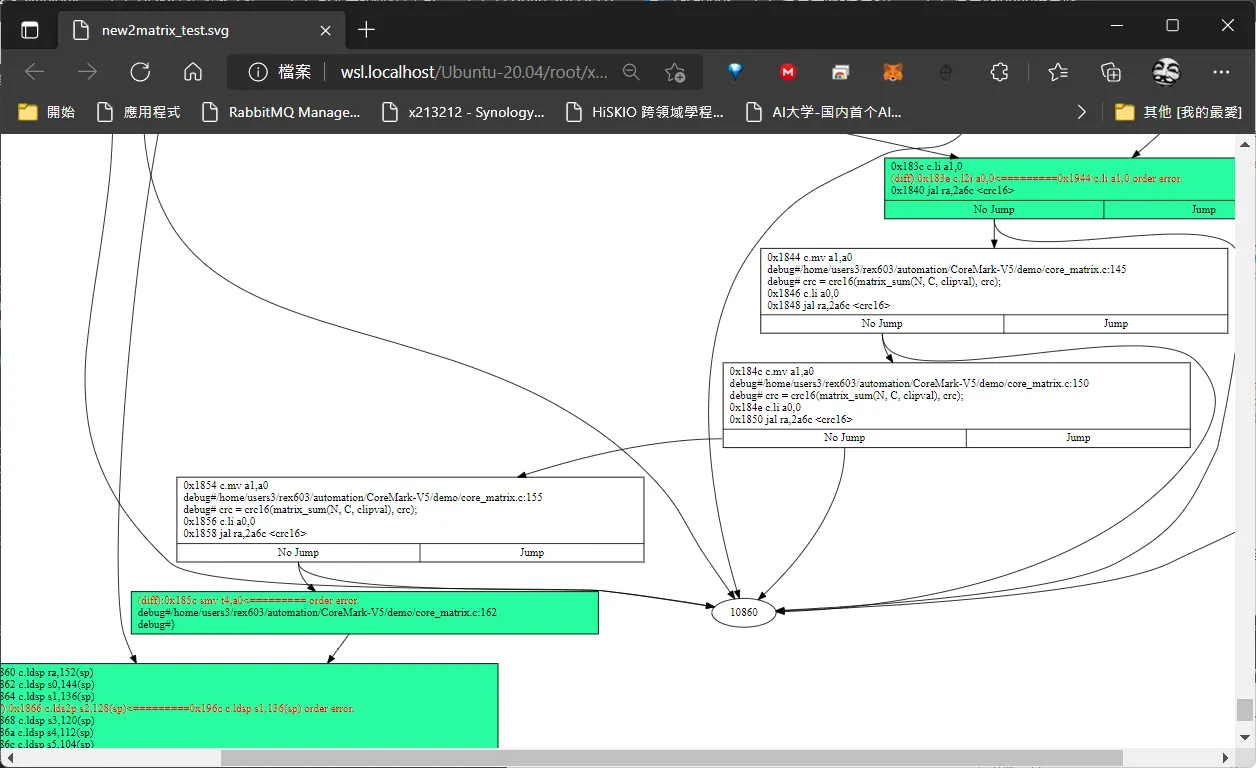
a.asm a2.asm https://gist.github.com/x213212/96bd63ef5df0ee3caebc3ee127dd0299 給定兩個asm 尋找相同模糊區間,假日稍微改了一下,遇到一些相同compiler 版本,有+option 而導致code gen 不同,要找出,asm不同的地方,對我來說實在非常的麻煩,cfg3可以大致的對區間進行模糊搜尋以找出不同的basic block 或者特殊inst
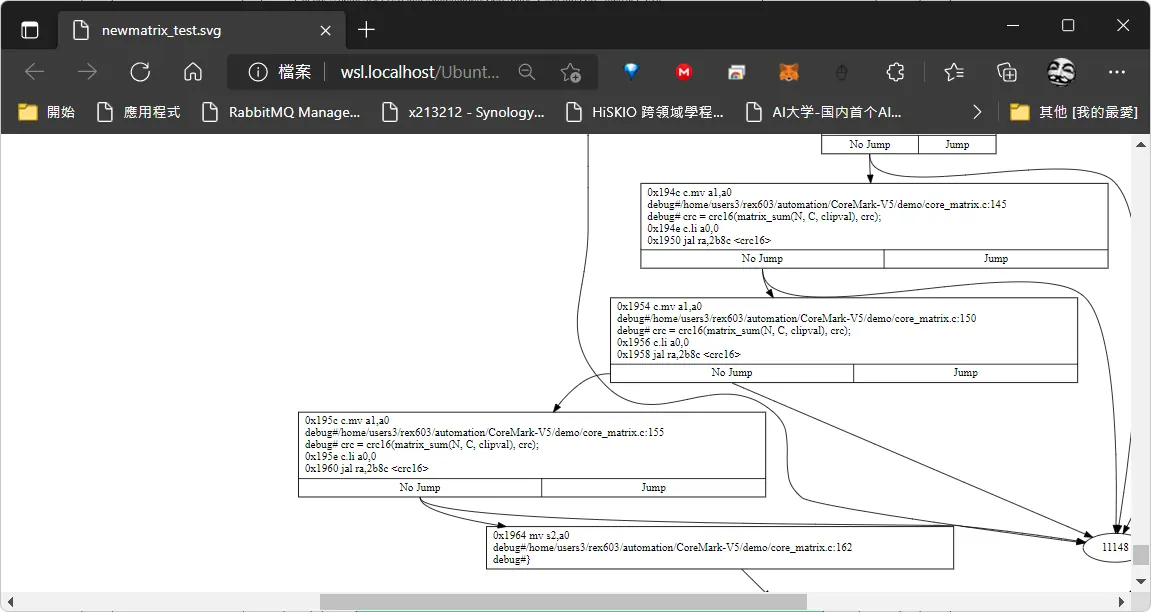
搜尋模糊區間匹配改用 匹配的inst/總basic inst算出比值,也新增了候選人basic block 名單找出 候選人中最相似的basic block 進行判斷, 至於檢測Unrooling loop區間,給予某個basic block 倒是可以用key value 累積inst 然後mod2取餘數,一樣inst過半的情況下進行Unrooling loop 檢測,大概把當前inst 取餘數由上到下統計到剩餘的inst就可以為這個basic block register進行再分組,有空再來實驗.
Comments